
EU Packaging & Packaging Waste Regulation (PPWR)
27 countries. One PPWR regulation.
No room for fragmented data.
PPWR replaces 27 different national packaging laws with a single, directly applicable regulation. Packaging accounts for 36% of all EU municipal waste, and the old Directive could not stop that growth. The new regulation sets the same precise requirements, substance limits, recyclability grades and recycled content targets, across all 27 member states from day one. A mandatory Annex VII technical file and EU Declaration of Conformity are required from 12 August 2026, with a retention period of five to ten years. It is not enough to be compliant. You must be able to prove it at any time.
For most companies, the challenge is not understanding what PPWR requires. It is collecting, validating and structuring the data that proves it. Supplier declarations are scattered, substance checks are manual, and compliance evidence lives across email inboxes and shared drives.
CDX turns your PPWR compliance data into something you can point to when an auditor asks.
Why this matters now
- Market access is at risk. Non-compliant packaging cannot be placed on the EU market.
- Your suppliers are part of your compliance. You depend on supplier data to complete conformity assessments and technical documentation.
- PPWR compliance builds your broader data foundation. The material and substance data collected for PPWR also supports REACH, SCIP, RoHS and ESG reporting.
- Packaging design affects compliance costs. EPR (Extended Producer Responsibility) fees increasingly depend on recyclability performance and recycled content.
- Enforcement is EU-wide and coordinated. Non-compliance findings can impact access to the entire European market.
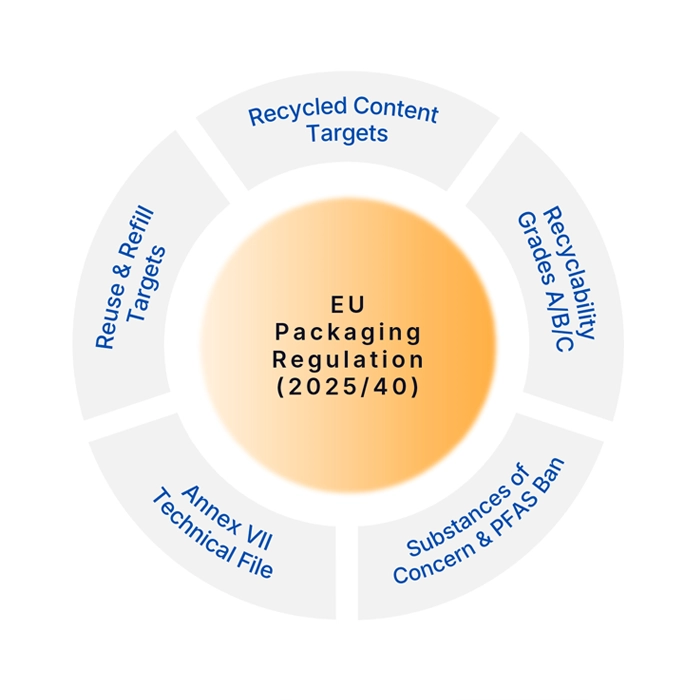
What does EU PPWR looks like in practice?
Challenge |
CDX Advantage |
|
|---|---|---|
| Substance data collected manually from individual suppliers, with no central place to see gaps or track completion status | Supplier declarations stored in a single workspace, with visibility into packaging items that still lack substance information | |
| No way to check whether substances in packaging materials appear on the SoC, SVHC or REACH Candidate List | Automated substance screening against regulatory lists, identifying SoC, SVHC and other restricted substances within existing material declarations | |
| Compliance evidence such as test reports, certificates and declarations scattered across email inboxes and shared drives | Compliance documents linked directly to packaging items and supplier records for easy access and traceability | |
| Supplier engagement managed through email threads, with no audit trail and low response rates | Structured supplier requests and reminder workflows with basic response tracking and auditability | |
| Compliance data maintained separately for each regulatory obligation, with PPWR, REACH, SCIP and RoHS handled in silos | A single dataset reused across multiple regulations, enabling the same material and substance data to support PPWR, REACH, RoHS and Conflict Minerals reporting | |
| No structured foundation for the Annex VII technical file, making audit preparation slow and inconsistent | A centralised documentation repository that helps assemble and maintain the PPWR Annex VII technical file more efficiently |
Navigating the EU Packaging
and Packaging Waste
This whitepaper provides a practical guide to key PPWR obligations, including EU Declarations of Conformity, technical documentation, recyclability and reuse requirements, while showing how organizations can turn fragmented supplier data into the structured evidence needed to demonstrate compliance.
Benefits of Using CDX
CDX simplifies and streamlines product compliance across industries by offering a powerful platform for material data management. It ensures compliance with global regulations, enhances supply chain transparency, and reduces operational risk.
Comprehensive Regulatory Compliance Across Multiple Industries
- CDX supports compliance with major global regulations like REACH, RoHS, SCIP, PFAS, California Proposition 65, EU POPs, TSCA, EU Battery Regulation (2023/1542), and more.
- CDX includes substance lists like AD-DSL, HEDSL, GADSL, RISL, and the IAEG PFAS List, ensuring industry-specific compliance coverage.
Simplified Supply Chain Communication
- Built-in workflows and multilingual communication tools enable seamless data exchange between suppliers and customers.
- Free for suppliers to respond to material data requests, improving data accuracy and response rates.
- CDX enables multi-tier data requests and traceability, reducing manual follow-ups and ensuring a smoother compliance process.
Automated Data Collection and Reusability
- CDX allows for data reuse by linking material declarations (MDS) and supplier inputs across multiple products and customers.
- It includes tools to import/export standardized data (e.g., IPC-1752A, IPC-1754), minimizing duplication and saving time.
SCIP Database Integration
- CDX automates the creation and submission of SCIP dossiers, ensuring compliance with EU Waste Framework Directive requirements.
- It supports ECHA´s API for direct uploads and manages required data such as substance of concern, article identifiers, and material categories.
Risk Mitigation
- Helps prevent product recalls by ensuring accurate tracking of hazardous and restricted substances throughout the product lifecycle.
- Supports early detection of non-compliant materials, reducing regulatory exposure and costly late-stage design changes.
Security & Data Protection
- Adheres to high security standards such as ISO certifications and Oracle-powered cloud infrastructure.
- Ensures secure data storage, controlled access, and compliance with global data protection regulations.
Easy Integration with Existing Systems
- Offers APIs and web services for smooth connection to ERP, PLM, and other enterprise systems.
- Compatible with multiple data formats including IPC, IEC, and IMDS, reducing technical friction.
One Platform - Two Powerful Solutions

Stay ahead of global regulations like REACH, SCIP, and RoHS with CDX´s Material Data Reporting tools. Collect, validate, and share material data across your supply chain with ease. Our advanced features ensure compliance, transparency, and streamlined communication.

Take control of your conflict minerals compliance with our Responsible Minerals Reporting solution. Designed for regulatory frameworks like the EU Conflict Minerals Regulation and the U.S. Dodd-Frank Act, CDX empowers your team to meet due diligence requirements and drive sustainable sourcing.
PPWR: What You Need to Know
What is PPWR (Regulation (EU) 2025/40)?
PPWR replaces Directive 94/62/EC, the packaging rules that existed since 1994, with a directly applicable regulation. No transposition, no national variations. The same binding requirements apply in all 27 member states from day one.
Under the old directive, each Member State wrote its own national law. Companies selling across the EU ran 27 parallel compliance programmes, with vague requirements and inconsistent enforcement. Packaging waste still reached 36% of all EU municipal waste, and the old directive could not stop this growth.
PPWR changes the structure fundamentally. It sets precise, quantified thresholds (percentages, dates, concentration limits) and introduces a mandatory Annex VII technical file and EU Declaration of Conformity. It is not enough to be compliant. You must be able to prove it at any time.
Crucially, industrial and B2B packaging is now fully in scope. If you ship automotive parts, machinery or industrial goods, your transport packaging carries PPWR obligations. There are no exceptions.
How is PPWR different from the previous EU Packaging Directive?
Directive 94/62/EC required national transposition, each EU Member State wrote its own implementing law, resulting in 27 different sets of rules. Industrial and B2B packaging was largely excluded, requirements were vague, and there was no mandatory technical file.
Regulation (EU) 2025/40 replaces this with a single, directly applicable law across all 27 member states. No transposition needed. The same precise, quantified requirements apply everywhere from day one. Industrial and B2B packaging is fully in scope. A mandatory Annex VII technical file and EU Declaration of Conformity are required.
What are the most important PPWR compliance requirements?
PPWR introduces several major obligations that companies must understand, document and demonstrate throughout the packaging lifecycle. These range from substance restrictions and recyclability requirements to recycled content targets, labelling obligations, technical documentation and Extended Producer Responsibility (EPR).
The overview below summarizes some of the most important PPWR requirements and compliance dates. It is intended as a practical guide and does not represent a complete interpretation of Regulation (EU) 2025/40. The full regulation may contain additional requirements that apply depending on your packaging type, market, and role in the supply chain.
|
Article 5 | From 12 Aug 2026 What does PPWR require for Substances of Concern and heavy metals?Heavy metals (Pb, Cd, Hg, Cr⁶⁺) must not exceed 100 mg/kg in any packaging. All packaging must be manufactured so Substances of Concern are minimised. SoC covers ~3,250 entries across CLP hazard classifications, REACH SVHCs, EU POPs, and recyclability-impeding substances. |
Article 5, Food Contact | From 12 Aug 2026 What are the PPWR PFAS limits for food contact packaging?Specific concentration limits apply to PFAS in food contact packaging: ≤25 ppb for any single non-polymeric PFAS, ≤250 ppb for the sum of targeted PFAS, ≤50 ppm total fluorine. These apply whether PFAS are intentionally added or unintentionally present. |
|
Article 6 | From Jan 2030 What are PPWR recyclability grades A, B and C?All packaging must be recyclable. Recyclability is expressed as grades A (≥95%), B (≥80%), or C (≥70%). From 2030, Grade C is the minimum to stay on the market. From 2038, only Grade A or B packaging may be placed on the EU market. |
Article 7 | From Jan 2030 What recycled content does PPWR require for plastic packaging?Plastic packaging must contain minimum proportions of recycled material: 30% for contact-sensitive PET and single-use bottles, 35% for other plastic packaging, 10% for contact-sensitive non-PET. These targets roughly double by 2040. Calculated as averages per plant per year. |
|
Articles 10 & 24 | From Jan 2030 What is the PPWR 50% void space rule?Packaging must be reduced to the minimum necessary in weight and volume. Empty space in grouped, transport and e-commerce packaging may not exceed 50% of total volume. Bubble wrap, paper fillers and air cushions all count as void space. |
Article 12 | From Aug 2028 What labelling and QR code requirements does PPWR introduce?Sales and e-commerce packaging must carry a harmonised EU sorting pictogram and a digital data carrier (QR code) linking to material composition, SoC data and end-of-life instructions. Transport and B2B packaging is exempt, but exemption must be formally documented in the Annex VII file. |
|
Articles 38–39 | From 12 Aug 2026 What PPWR documentation is required?Manufacturers must prepare an Annex VII technical file covering packaging design, materials, applied standards, and test reports, then issue an EU Declaration of Conformity. Retention period: 5 years for single-use, 10 years for reusable. |
Article 44 | From 12 Aug 2026 What are the PPWR Extended Producer Responsibility requirements?Producers (manufacturers, importers or distributors first placing packaged products on the market) must register in each EU member state, report annually on packaging volumes and recycling performance, and finance end-of-life management costs. |
Who is responsible for PPWR compliance?
Under PPWR, obligations differ depending on your position in the supply chain. One company can hold multiple roles simultaneously, each carrying different legal requirements.
|
Article 15 The Manufacturer Ensures compliance with PPWR technical requirements. Prepares the Annex VII technical file. Issues the EU Declaration of Conformity. Bears sole legal responsibility for the conformity assessment, even where suppliers provide the underlying data. This role applies to any entity placing packaging on the EU market under its own name or trademark, regardless of who physically produced it. |
Article 18 The Importer Must verify that required documentation is in place before placing packaging on the market. Must keep documentation available for the required retention period (5 or 10 years). Cannot place packaging on the market if it does not comply with applicable requirements. |
|
Article 19 The Distributor Must verify that relevant obligations have been fulfilled and act with due care before making packaging available on the market. The distributor is responsible for confirming that documentation exists — even if they had no part in designing, manufacturing or importing the packaging. |
Article 16 The Supplier Must provide the manufacturer with all information and documentation needed to demonstrate conformity with applicable PPWR requirements. This includes substance data, material declarations, test reports and other technical information relevant to the packaging materials and components they supply. |
Who counts as the legal "manufacturer" under PPWR?
Under Article 15, the manufacturer is any EU or non-EU entity that places packaging on the market under its own name or trademark.
Critically, if you purchase packaging from a third-party producer but brand it as your own, you are legally the manufacturer: the full conformity assessment, technical file preparation and Declaration of Conformity are your responsibility. The physical producer of the packaging is not the legal manufacturer in this scenario.
Do PFAS and BPA restrictions apply to all packaging under PPWR?
No. The BPA ban (Regulation EU 2024/3190) and PFAS concentration limits (Article 5(5) PPWR) apply specifically to food contact packaging. For non-food-contact packaging, the general requirement is to minimise all Substances of Concern, including heavy metals (≤100 mg/kg), across all packaging types.
If your customers do not include food contact packaging manufacturers, specific PFAS/BPA obligations from Article 5(5) will not directly apply to your product scope, though general SoC minimisation requirements still do.
What is a "Substance of Concern" under PPWR?
PPWR borrows the SoC definition from the Ecodesign for Sustainable Products Regulation (ESPR).
It covers approximately 3,250 substances across four categories:
- ~3,250 harmonised CLP hazard classifications including carcinogens, mutagens, reproductive toxicants, endocrine disruptors, and environmental hazards;
- 253 REACH SVHCs from the Candidate List;
- 34 EU Persistent Organic Pollutants;
- an "open list" of substances that negatively affect recyclability, to be defined through Delegated Acts.
Importantly, SoC is broader than SVHC: REACH substances are just one of the four categories.
Does PPWR require sorting labels and QR codes for transport and B2B packaging?
Transport and industrial B2B packaging is exempt from the mandatory sorting pictogram and QR code.
However, e-commerce packaging is not exempt. Even if it physically functions as outer transport packaging, if it delivers products to end consumers through an online channel, labelling obligations apply.
Exemption is not automatic: you must formally assess your packaging categories and document the basis for any exemption claim in your Annex VII technical file. That obligation is active from 12 August 2026.
What is the "5% plastic rule" under PPWR and why does it matter?
Under Article 7(1), if plastic makes up less than 5% of total packaging weight, the packaging is exempt from single-use plastic restrictions. But if plastic reaches or exceeds 5%, even by a small margin, the entire packaging unit is legally reclassified as single-use plastic, regardless of its primary material.
A practical example: paper packaging with a thin plastic moisture liner. If that liner reaches 5% of total packaging weight, the packaging is legally reclassified as plastic. Labels, varnishes, inks and adhesives are excluded from this calculation.
How long must PPWR compliance documentation be retained?
The Annex VII technical file and the EU Declaration of Conformity must be kept
- for a minimum of 5 years for single-use packaging, and
- 10 years for reusable packaging.
The retention period runs from the date the packaging is last placed on the market. Manufacturers must also reassess documentation whenever packaging design changes or when applicable standards are updated.
What does the PPWR compliance timeline look like?
PPWR obligations apply in waves, not all at once. Understanding which deadline applies to which requirement is essential for planning. The dates below are key examples, not a complete list.
PPWR Compliance News & CDX Updates

Stay informed. Get the latest regulatory updates, compliance insights, and CDX news delivered to your inbox.
Explore the Regulatory Landscape

Use CDX to report substances of concern and ensure your products meet EU SCIP database requirements.

CDX helps you manage and document chemical substances across your supply chain to comply with REACH.

Leverage CDX to track and limit hazardous substances in electronics and electrical equipment efficiently.

CDX supports your efforts to identify, assess, and manage PFAS usage across evolving global regulations.

CDX helps you identify and manage chemicals listed under California´s Proposition 65 requirements.

Track and manage Persistent Organic Pollutants (POPs) in your products using CDX to meet EU regulatory obligations and protect environmental and human health.
Optimize Compliance. Stay compliant and competitive in a changing regulatory landscape.
cdx-servicedesk@dxc.com.
Ask me a question or choose one of the following options: